Quick answer: Generative AI consulting for customer support operations succeeds or fails on adoption, not model accuracy. If frontline agents were not asked how the workflow should change and no pass/fail criteria exist before launch, a support AI tool can get quietly routed around, no matter how well it drafts answers.
Table of Contents
The Question That Matters More Than Model Accuracy
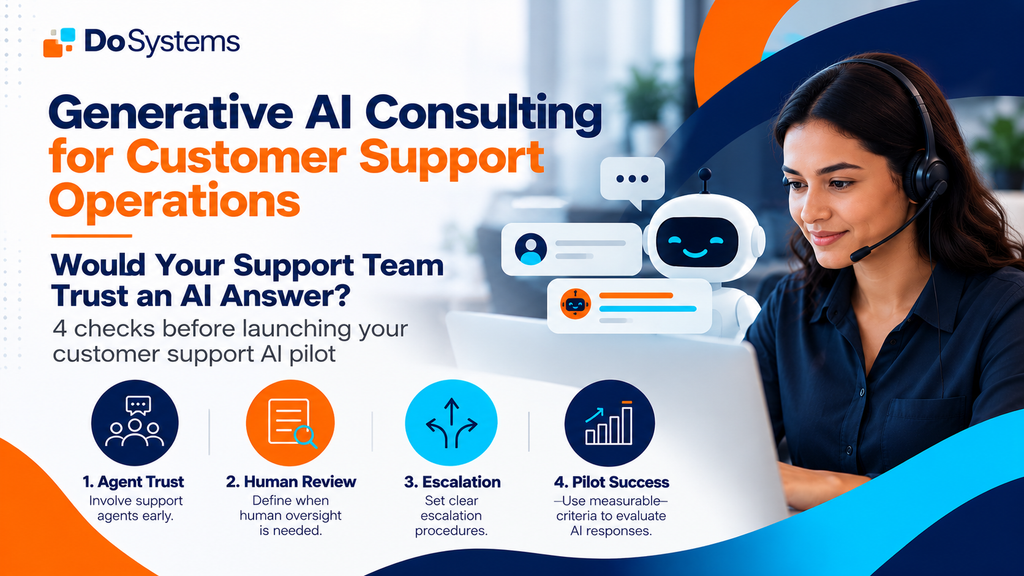
Here is the question a support operations leader should ask before signing off on any generative AI tool: would the agents on this floor trust an AI-drafted answer enough to send it without rewriting it first?
If the honest answer is no, the accuracy of the underlying model is almost beside the point.
A tool can draft a technically correct response and still get ignored if the agent using it does not trust it, was not consulted on how it should fit into their workflow, or fears what it means for their job.
When that happens, agents route around the tool quietly.
They copy the draft, rewrite half of it, or stop opening the panel altogether.
Ticket backlog does not move. Leadership sees low usage numbers and may assume the model was the problem, when the actual cause could be adoption.
This is why generative AI consulting for customer support operations must evaluate how employees interact with AI-generated responses, not simply whether the technology produces accurate answers.
A successful implementation depends on whether the tool fits into the daily workflow and whether agents feel confident using it.
What Happens When Agents Aren’t Asked
Picture a support team that rolls out a generative AI drafting tool by announcement.
An email goes out, a training video is linked, and the tool appears in the ticketing system overnight.
If the agents who will use it every day were not involved in defining how the workflow changes, several predictable problems can occur.
Agents may assume the tool is there to replace headcount rather than assist them.
Instead of viewing AI as a way to reduce repetitive work, they may see it as a threat to their roles.
Team leads may not know how to coach employees on when to trust an AI-generated draft and when to rewrite it.
If there is no feedback mechanism for agents to flag inaccurate or unsuitable responses, the organization also loses an opportunity to improve the tool.
The AI system may continue producing answers that don’t match the team’s tone, policies, or customer expectations.
None of this is necessarily about whether the model can generate a grammatically correct or technically accurate response.
It is about whether the people expected to use the technology were ever asked how it should work.
In generative AI consulting for customer support operations, frontline feedback should be considered a core implementation requirement rather than an optional improvement after launch.
Organizations should understand how agents handle customer questions, identify where AI assistance would be useful, and establish a process for reviewing problematic responses.
Without this involvement, automation may create additional work rather than reducing it.
Checklist Point 7: The Adoption Plan You Skipped
The AI Readiness Checklist addresses this directly in point 7: do the people who will use the technology want it, and have they been asked?
A ready organization involves frontline users in defining the workflow.
Employees understand what changes for them, how the technology supports their responsibilities, and where they can provide feedback.
They also receive appropriate training before the system becomes part of their daily work.
The warning sign is a tool introduced through an announcement, with little employee involvement and uncertainty about whether AI threatens existing jobs.
A responsible generative AI consulting for customer support operations approach should include an adoption plan that addresses employee concerns before deployment.
Support leaders should be able to answer several practical questions.
Do agents understand which responses AI can draft? Do they know when human review is required? Can they report incorrect answers or recommend improvements?
If a support operations manager cannot identify specific agents who helped shape how AI drafts are reviewed, edited, or escalated, that is not a minor detail to resolve later.
It is a warning that the rollout may already be at risk, regardless of which vendor or model was selected.
A team that skips this step is not simply testing whether AI works.
It is testing whether employees will tolerate being handed a tool they had no role in designing.
Treating adoption as a design requirement gives generative AI consulting for customer support operations a stronger foundation for long-term success.
The goal is not merely to encourage employees to use AI. It is to create a workflow in which AI assistance is useful, understandable, and trusted.
Checklist Point 8: Success Criteria Before You Start
The second blind spot sits directly beside adoption.
Checklist point 8 asks whether pass/fail criteria were defined before the AI pilot started.
A prepared organization establishes a target metric, a minimum acceptable threshold, and a review date.
It also determines what happens if the pilot fails to meet expectations.
Will the organization expand the solution, improve it, or stop the project?
The warning sign is a pilot that ends when the demonstration looks impressive, with success defined only after results become available.
For generative AI consulting for customer support operations, success criteria should measure both operational performance and practical adoption.
For example, a support team might track average handle time, the percentage of AI drafts accepted without substantial rewriting, agent satisfaction, or the number of responses requiring escalation.
These measures help leaders understand whether AI is improving the workflow or simply adding another step.
If a team launches a generative AI drafting tool without agreeing on what success looks like, the results become difficult to interpret.
A reduction in response time may appear encouraging, but it means little if agents spend additional time correcting inaccurate drafts.
Likewise, high model accuracy does not automatically mean the tool is delivering value if employees rarely use it.
A strong generative AI consulting for customer support operations pilot should therefore establish clear performance expectations before deployment.
Without predetermined criteria, almost any outcome can be presented as a success or failure depending on who is reviewing the results.
The purpose of a pilot is to test whether an approach works under defined conditions, not simply to demonstrate that the technology can produce answers.
What Generative AI Consulting for Customer Support Operations Should Assess
Adoption and success criteria are only two of the ten points on the AI Readiness Checklist.
However, they are among the easiest to overlook when support leaders are under pressure to reduce ticket backlogs or improve response times.
The NIST AI Risk Management Framework provides guidance for evaluating AI trustworthiness and managing risks throughout implementation. For customer support teams, these principles can help establish responsible human oversight, clearer review procedures, and more reliable AI-assisted workflows.
The remaining readiness checks address the business case, a clearly defined use case, data access, systems integration, security and compliance, ownership, budget and timeline, and the build-versus-buy decision.
Each area is scored from 0 to 2, producing a total readiness score out of 20.
When evaluating generative AI consulting for customer support operations, leaders should consider these operational requirements alongside the capabilities of the AI model.
A support team that scores highly on technical readiness but poorly on adoption and success criteria may still struggle to implement AI successfully.
For example, the technology might integrate perfectly with the existing ticketing platform and generate accurate responses.
However, if agents were never asked how the workflow should change, they may continue relying on their existing processes.
Similarly, if success was not defined before the pilot, leadership may struggle to determine whether the solution should be expanded.
These are people and process problems rather than purely technical limitations.
No amount of prompt engineering can independently resolve unclear responsibilities, employee concerns, or missing success criteria.
Organizations should therefore evaluate readiness across three practical areas.
1. Agent trust and adoption
Determine whether frontline employees understand the technology, have participated in workflow design, and know how to provide feedback.
2. Human review and escalation
Establish when an AI-generated answer can be used, when human approval is necessary, and how uncertain or sensitive customer situations should be escalated.
3. Measurable pilot outcomes
Define the operational metrics, acceptance thresholds, and review dates that will determine whether the solution is delivering measurable value.
These considerations help connect the technical capabilities of generative AI with the daily realities of customer support operations.
Where to Start Before You Pick a Vendor
Before evaluating generative AI vendors for customer support, a support operations leader should assess the team against all ten readiness points, not just the technical ones.
A team that scores zero on adoption or success criteria has a clear problem to address before investing in a pilot.
A team that performs well in both areas has a stronger foundation for implementing technology that employees will actually use.
Before commissioning generative AI consulting for customer support operations, organizations should identify where existing workflows create friction and whether employees are prepared to adopt new processes.
Start by speaking directly with the people handling customer interactions every day.
Ask which tasks consume the most time, where repetitive work occurs, and which decisions require human judgment.
Then define one specific use case where AI could provide measurable assistance.
Establish ownership, clarify how AI-generated responses will be reviewed, and agree on success criteria before implementation begins.
These steps help organizations avoid investing in technology that looks impressive during a demonstration but fails to improve daily operations.
If you are considering generative AI consulting for customer support operations, the AI Readiness Checklist provides a structured way to identify gaps before committing to a vendor or pilot.
The goal is to determine whether your team is ready to make AI part of its workflow, not simply whether an AI model can generate a convincing response.
FAQ
Why might support agents ignore an accurate generative AI draft?
Agents may ignore an accurate AI-generated response if they were not involved in designing the workflow or do not understand how the tool is intended to support their responsibilities.
Some employees may also worry about how automation affects their jobs.
Accuracy alone cannot resolve these concerns.
Support leaders should involve agents in workflow design, provide training, and establish a feedback process for identifying unsuitable responses.
These actions directly support checklist point 7, which focuses on adoption readiness.
What should a support operations team define before starting an AI pilot?
Teams should establish clear pass/fail criteria before implementation.
These include a measurable target, a minimum acceptable threshold, a review date, and a predetermined decision about whether to expand, improve, or stop the pilot.
For customer support, relevant metrics may include average handle time, AI draft acceptance rates, agent satisfaction, and escalation frequency.
Generative AI consulting for customer support operations should help organizations select metrics that reflect meaningful improvements rather than relying on model performance alone.
Without clear criteria, pilot results may be difficult to evaluate objectively.
Is model accuracy the main risk when deploying generative AI in a support team?
Model accuracy is important, but it is not the only factor that determines whether an AI implementation succeeds.
A support rollout can fail even with an accurate model if employees do not trust the system or were not consulted during workflow design.
The absence of measurable success criteria creates another risk.
With generative AI consulting for customer support operations, organizations should evaluate both technical performance and operational readiness before committing to a full deployment.
These considerations are covered separately in the AI Readiness Checklist.
How can generative AI consulting for customer support operations improve agent trust?
The process should begin by involving frontline support employees before an AI tool is introduced.
Agents can help identify repetitive tasks, define appropriate use cases, and establish procedures for reviewing AI-generated answers.
Organizations should also communicate how AI assistance will affect existing responsibilities.
Providing training, transparent escalation procedures, and a reliable feedback mechanism can help employees develop confidence in the system.
The objective is to make AI a useful part of the support workflow rather than introducing technology that employees feel pressured to use.
Start With the AI Readiness Checklist
Before investing in a customer support AI solution, evaluate whether your organization is ready to implement it successfully.
The AI Readiness Checklist helps support leaders assess ten important areas, including employee adoption, process ownership, data readiness, security, and measurable success criteria.
Use it to identify potential blockers, prioritize improvements, and approach AI vendor conversations with a clearer understanding of what your support team actually needs.
Comments are closed