
Quick answer: An AI readiness assessment for finance and accounting operations helps finance leaders determine whether their month-end close processes are ready for automation. Before investing in AI tools, teams should evaluate their business case, data accessibility, ERP integration, security, process ownership, and measurable outcomes. A successful AI pilot starts with a process that is ready to support it, not simply a promising technology demonstration.
Table of Contents
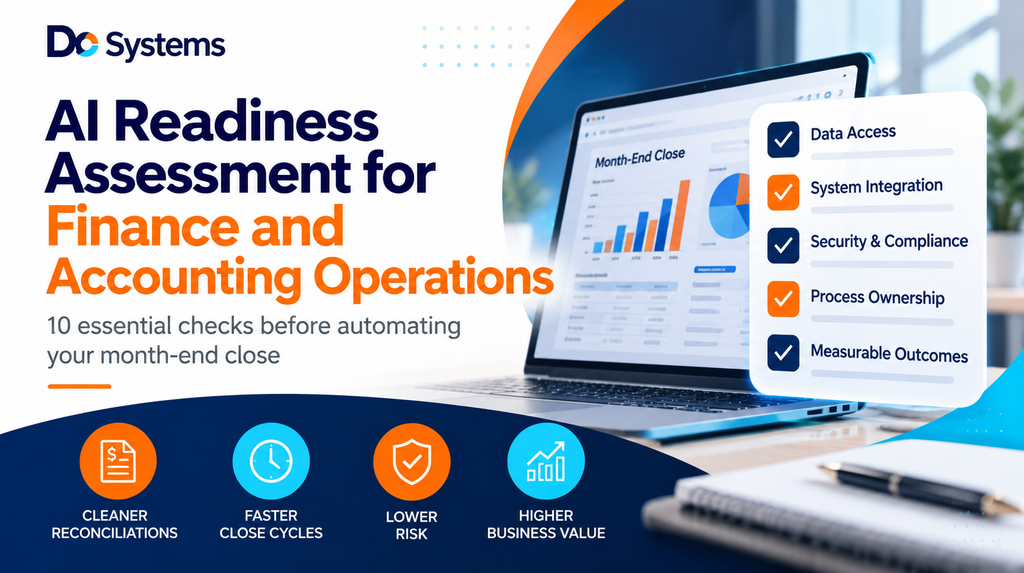
If a Vendor Pitches Close Automation Next Month, Ask This First
If a vendor pitches a reconciliation bot, anomaly detection, or automated journal entries for month-end close, the proposal can sound reasonable on the surface.
The harder question a controller should ask before that meeting is not whether the tool works, but whether the close process itself, and the data behind it, is ready for AI.
An AI readiness assessment for finance and accounting operations helps answer that question before a business commits time and resources to a pilot.
The AI Readiness Checklist provides ten points to evaluate before any vendor conversation.
Three of these are particularly important: data access, security and compliance, and ownership.
If a close process scores zero on any of these critical points, it is not ready yet, regardless of how capable the proposed tool may be.
Identifying these gaps early gives finance leaders a clearer understanding of what needs to change before automation can deliver measurable value.
Conducting an AI readiness assessment for finance and accounting operations also helps organizations distinguish between processes that are ready for automation and those that require operational improvements first.
AI Readiness Assessment for Finance and Accounting Operations: The First Three Checks
1. Business Case: Define the Value Before the Technology
If a finance team can explain the value of applying AI to month-end close in one sentence, with a measurable outcome attached, it has the beginning of a business case.
That outcome might be hours saved on a specific reconciliation, fewer manual journal entries, or a measurable reduction in close-cycle days.
If the answer is simply “we want to use AI for close,” with no metric attached, that is the red flag this readiness check is designed to identify.
An effective AI readiness assessment for finance and accounting operations should begin with the business outcome the organization wants to achieve.
The question is not just what AI can automate, but which operational problem is worth solving.
For finance leaders, this means identifying a specific process where automation could reduce costs, improve accuracy, or free employees from repetitive work.
Without a measurable business objective, even a technically successful AI implementation may struggle to demonstrate its value.
2. Use Case: Start With One Process
The same principle applies to selecting a use case.
A team that identifies one high-value process, such as bank reconciliation or intercompany eliminations, and assigns it to a named accounting manager is in a stronger position than a team considering fifteen possible AI applications without clear ownership.
Trying to automate several accounting processes simultaneously makes it harder to understand which changes produce meaningful improvements.
A more practical approach is to start with one repetitive, measurable workflow.
This gives the team a defined scope, clear responsibilities, and a realistic opportunity to evaluate results before expanding automation.
During an AI readiness assessment for finance and accounting operations, selecting one use case helps finance leaders identify the workflow most likely to benefit from automation.
Starting with a single process also makes it easier to measure performance, identify implementation challenges, and determine whether the approach should be expanded.
3. Data Access: Identify the First Potential Blocker
Data access is where a close workflow can stall before AI is even introduced.
Consider a reconciliation process where information is spread across bank statements, ERP exports, and a spreadsheet maintained by one employee.
If nobody can identify who controls access to each source, the process has a significant readiness gap.
A practical test is whether the finance team can retrieve the necessary information within a week without starting a separate data project.
If the answer is yes, the organization is in a stronger position to move forward.
If not, improving data access should become the priority before launching an automation pilot.
The purpose of an AI readiness assessment for finance and accounting operations is to uncover these issues before they become expensive implementation problems.
Reliable data access allows automation tools to operate against consistent information rather than disconnected spreadsheets or manually updated records.
Finance leaders should identify where critical financial data is stored, who controls access, and whether the information can be retrieved securely and consistently.
Systems Integration and Security: The ERP and Compliance Checks
4. Systems Integration: Can AI Work With Existing Tools?
A month-end close process typically depends on several systems, including the general ledger, ERP, bank feeds, and potentially a standalone reconciliation platform.
The readiness question is whether the team understands which systems an AI solution needs to access and where its outputs must go.
It is also important to confirm whether those systems support APIs or other reliable integration methods.
For example, if AI identifies a reconciling item but an accountant must manually transfer the result into the ERP, the process still contains a significant manual step.
Even if the AI performs its assigned task correctly, the overall workflow may remain inefficient.
An AI readiness assessment for finance and accounting operations should therefore examine the complete workflow rather than the performance of an individual tool.
Finance teams should also verify that information can move securely between existing platforms without introducing unnecessary manual steps.
Successful automation depends on how well AI fits into existing financial processes, not simply whether the technology works independently.
5. Security and Compliance: Protect Financial Information
Security and compliance sign-off matters just as much as technical functionality.
Financial systems contain sensitive information, including bank account numbers, vendor terms, payroll figures, and internal financial records.
If employees are already pasting close data into public AI tools without an approved policy, that is a risk that needs attention.
The same applies when no one from security or compliance has confirmed whether sensitive information can leave the organization’s environment.
Before starting a pilot, finance leaders should establish clear answers about data classification, hosting requirements, access permissions, and information handling.
The NIST AI Risk Management Framework provides guidance for managing AI-related risks, including considerations around security, reliability, transparency, and accountability.
For finance teams, the practical takeaway is straightforward: understand how the technology handles sensitive information before allowing it into critical accounting workflows.
Security and compliance should be included in every AI readiness assessment for finance and accounting operations, particularly when automation involves confidential financial records.
A written security and compliance assessment provides a stronger foundation than assumptions made during a vendor demonstration.
Organizations should also establish who can access sensitive information, how AI-generated outputs will be reviewed, and which controls apply throughout the process.
Ownership, Adoption and Success Criteria for a Close Pilot
6. Ownership: Assign Accountability Before Launch
A close-automation pilot without a named owner can lose direction once the initial excitement surrounding the technology fades.
The AI Readiness Checklist calls for one accountable business owner, ideally a controller or assistant controller, supported by a technical counterpart.
An executive sponsor should also be available to remove blockers and help the project move forward.
If the initiative belongs only to “IT” or “innovation,” while the accounting team has little involvement, ownership problems may appear during rollout.
These problems are usually easier to address before implementation than after a new system becomes part of the close process.
An effective AI readiness assessment for finance and accounting operations should identify who owns the business outcome, who manages technical execution, and who has authority to resolve issues.
Clear ownership also ensures that someone is responsible for reviewing results, resolving exceptions, and evaluating whether the automation is delivering the expected benefits.
Technology can improve efficiency, but accountability must remain with the people responsible for the financial process.
7. Adoption: Involve the People Doing the Work
Employee adoption is a separate question from project ownership.
If the accountants responsible for reconciliations help define the proposed workflow, they can identify practical challenges before the pilot begins.
They should also understand what changes when AI enters the process.
For example, employees may spend less time matching routine transactions and more time reviewing exceptions that require professional judgment.
The transition becomes more manageable when responsibilities and expectations are explained clearly.
However, if a new tool arrives without meaningful employee involvement, resistance should not come as a surprise.
People need to understand how the technology will support their work, what decisions remain theirs, and how the organization plans to manage the transition.
An AI readiness assessment for finance and accounting operations should therefore evaluate whether employees understand the proposed changes and have opportunities to participate in the implementation process.
Involving accounting teams early can help identify workflow problems, reduce confusion, and support more effective adoption.
8. Success Criteria: Measure Results, Not Demonstrations
Success criteria should be established before a pilot begins, not after.
A strong pilot includes a measurable target, a minimum acceptable threshold, and a defined review date.
It should also include a clear decision about what happens when the pilot ends.
Will the organization expand the solution, improve the workflow, or stop the project?
Without predetermined criteria, a pilot may be judged mainly on whether the demonstration looked impressive.
An AI readiness assessment for finance and accounting operations gives finance leaders an opportunity to establish meaningful success measures before committing to implementation.
For example, a reconciliation pilot could track processing time, exception rates, manual review effort, or the number of unresolved items at close.
These metrics help determine whether automation is improving the business process rather than simply introducing another technology.
The results should be compared against a documented baseline so that finance leaders can evaluate whether the pilot has delivered measurable improvements.
Budget, Timeline and the Build-vs-Buy Question
9. Budget and Timeline: Plan Beyond the Pilot
Funding a pilot is not the same as funding a complete implementation.
A project may have enough money to build and test an automation tool but lack the resources required for deployment, training, integration, and ongoing support.
The AI Readiness Checklist identifies this as a common warning sign: pilot funded, rollout unfunded.
Finance leaders should confirm that both stages have realistic budgets and timelines.
They should also identify the people responsible for implementing the solution after the pilot concludes.
Without this planning, even a technically successful pilot can struggle to deliver value across the organization.
A thorough AI readiness assessment for finance and accounting operations should consider the full implementation lifecycle, including ongoing maintenance, employee training, and technical support.
Planning for these requirements early helps organizations avoid situations where a successful pilot cannot move into production.
10. Build, Buy or Partner: Consider Long-Term Ownership
The final readiness check asks whether the organization should build a solution internally, purchase an existing product, or work with a technology partner.
A finance team with strong internal data engineering capabilities may have the resources to develop a reconciliation matching engine in-house.
Another organization may benefit more from an established platform or a specialized implementation partner.
The important question is not simply who can deliver the first working version.
It is who will monitor performance, resolve technical issues, maintain integrations, and support the system after launch.
A successful AI readiness assessment for finance and accounting operations should consider these ongoing responsibilities alongside implementation costs and expected benefits.
Choosing the right approach requires an understanding of internal capabilities, operational priorities, and the resources available for long-term support.
Finance leaders should evaluate each option based on total cost, implementation complexity, security requirements, and the ability to maintain the solution over time.
Score It, Then Talk to Vendors
Evaluating month-end close against these ten readiness checks changes the conversation with AI vendors.
Instead of reacting to a sales presentation, finance leaders can approach the discussion with a clearer understanding of their business objectives, available data, integration requirements, and operational risks.
They can identify which problems need to be solved before implementation and which opportunities are ready for a pilot.
Most importantly, they can distinguish between technology that looks promising and a project that is genuinely prepared to deliver measurable results.
Completing an AI readiness assessment for finance and accounting operations before vendor discussions helps controllers and finance leaders make more informed decisions about automation investments.
The AI Readiness Checklist provides a structured way to evaluate all ten areas, with scoring guidance for each one.
Rather than starting with a tool, start with an honest assessment of the process.
A structured AI readiness assessment for finance and accounting operations can help organizations prioritize improvements, identify potential risks, and establish a clearer path toward automation.
FAQ
What does AI readiness mean for a month-end close process?
AI readiness means evaluating whether the close process itself is prepared to support automation.
This includes a measurable business case, one defined use case, accessible data, ERP integration, security approval, clear ownership, employee adoption, pilot success criteria, funded implementation, and a build-vs-buy decision.
If data access, security approval, or ownership is missing, those gaps should be resolved before starting an AI pilot.
An AI readiness assessment for finance and accounting operations helps identify these gaps before organizations invest in new technology.
What is the biggest red flag in a close process that isn’t ready for AI?
One of the biggest warning signs is inaccessible or poorly managed financial data.
If reconciliation information is scattered across personal spreadsheets, inboxes, and ERP exports that only one employee knows how to retrieve, automation may struggle to operate reliably.
A lack of clear ownership is another major concern.
An AI project without a named accounting leader responsible for its outcomes can encounter significant problems during implementation.
Identifying these issues early is an important part of evaluating whether a financial process is ready for automation.
Should a finance team build AI reconciliation tools in-house or buy a vendor product?
The decision depends on internal technical capabilities, available resources, maintenance requirements, and the expected time to value.
Organizations with strong engineering teams may have the capacity to develop customized solutions.
Others may benefit from purchasing an established product or partnering with a specialist.
The evaluation should include long-term monitoring, maintenance, support, and integration responsibilities rather than focusing only on the initial development cost.
A comprehensive AI readiness assessment for finance and accounting operations can help decision-makers understand which implementation approach best fits their existing capabilities.
How can finance leaders begin an AI readiness assessment?
Start by selecting one specific month-end close process, such as bank reconciliation or journal-entry review.
Evaluate the business case, data availability, system connectivity, security requirements, and process ownership.
Then define measurable success criteria and determine whether the organization has the resources to support a pilot and subsequent rollout.
An AI readiness assessment for finance and accounting operations provides a structured starting point for identifying operational gaps and determining which workflows are suitable for automation.
Start With the AI Readiness Checklist
Before investing in an AI solution for month-end close, evaluate whether your finance operations are ready to support it.
The AI Readiness Checklist helps you assess ten critical areas, identify potential blockers, and approach vendor conversations with greater clarity.
Completing an AI readiness assessment for finance and accounting operations can help your team focus on the right processes, establish clear ownership, and make more informed decisions about AI investments.
Comments are closed