Your AI gateway became production infrastructure while nobody was looking
AI gateways usually arrive quietly. A developer adds one to stop juggling API keys and it proves useful. Within a few months, every internal copilot, chatbot and automation routes through it. At that point it sits on the critical path for everything AI-powered your company runs, yet it often still has the monitoring and change control of a side project.
That mismatch is the real risk. Nobody would run a payment service whose startup depended on an unmonitored external file. Yet that is the shape of the issue LiteLLM’s maintainers fixed. A feature fetched pricing data at startup, and under some conditions that could stop the proxy from starting at all.
What the October 25 patches reveal about hidden outbound dependencies
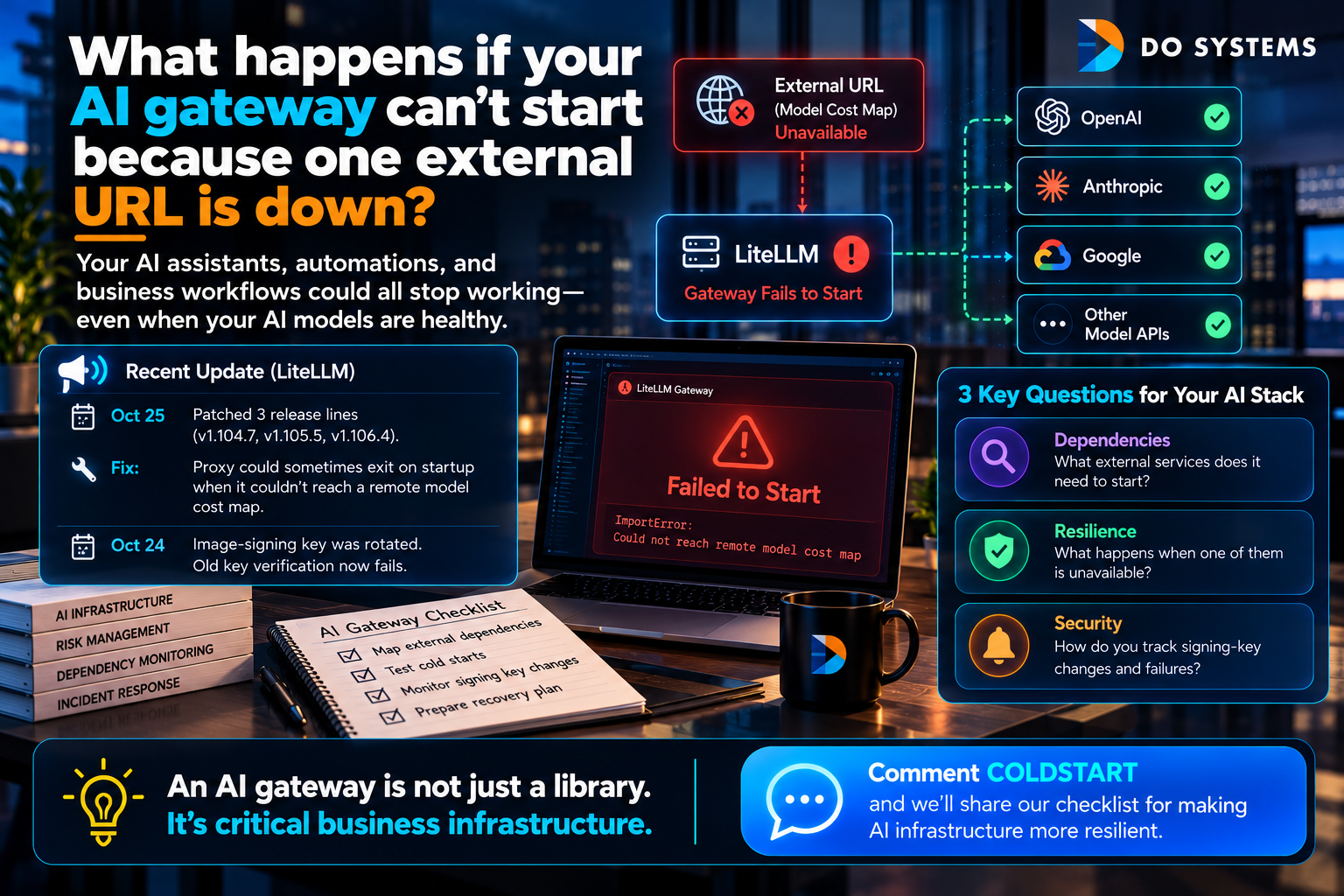
The release notes are worth reading closely. The startup fix shipped in three release lines at once, v1.104.7, v1.105.5 and v1.106.4, because the problem had been present since v1.104.0. A fourth release, v1.103.9, shipped the same morning with a fix for container image scans that flagged certain packages and certificates. That is responsible maintenance, and the project deserves credit for backporting the fix.
It also shows how long a team could have run an affected version without knowing its gateway made an outbound call at startup. The broader point applies to every AI component, not just this one. Model routers, vector databases, agent frameworks and observability SDKs often phone home for pricing tables, model catalogs or telemetry. Those calls rarely appear on the architecture diagram.
The cold-start test: three questions for every AI component you run
We use a simple diagnostic with clients, and it fits on a sticky note. For every AI component in the request path, answer three questions. What does it call home at boot? What breaks if that call fails? Who gets told when its signing key changes?
Answer the first question by experiment, not from the docs. Start the component in a staging environment with outbound internet blocked, except for the model providers you actually use, and watch what fails. Anything that refuses to start, hangs or logs repeated connection errors is a dependency you now know about.
The second question decides what to do about each dependency. Some calls can be switched off with a configuration flag. Others can point at a local copy of the data, and some need a fallback. The goal is that losing a non-essential outside service degrades one feature instead of taking down every AI tool in the company.
The third question leads to the next section, because it’s the one most teams haven’t considered at all.
Signing keys and trust stores are now part of your AI supply chain
One day before the startup fix, on October 24, LiteLLM rotated the key it uses to sign its Docker images and Helm charts. Its notes warn clearly that verifying with the previous key will fail. The project also removed a root certificate authority from the certificate bundles it trusts. Both changes are good security hygiene, and both can break a careful deployment.
Your CI pipeline or cluster admission policy should be verifying image signatures. If it is, an upstream key rotation blocks your next upgrade until someone updates the pinned key. Teams that verify signatures are safer, but they need a process for these events. Treat an AI vendor’s signing-key change like an expiring TLS certificate: a scheduled task with an owner, not a surprise.
An illustrative example: the morning the copilots went dark
Here is an illustrative scenario. It is not a real client, and the figures are hypothetical. A 300-person company routes its internal support copilot, sales email drafting and document search through one self-hosted AI gateway. A routine node restart coincides with a brief network blip and the gateway fails to boot. Nobody on call recognizes the cause, and every AI tool in the company stays down for three hours on a Monday morning.
Say 150 employees rely on those tools and each loses 40 minutes of productive work. That is 100 hours of lost time. At a blended cost of $70 an hour, the outage costs about $7,000, plus the harder-to-price damage of staff deciding the AI tools aren’t dependable. A one-afternoon cold-start test would have exposed the weakness in advance.
Comments are closed