
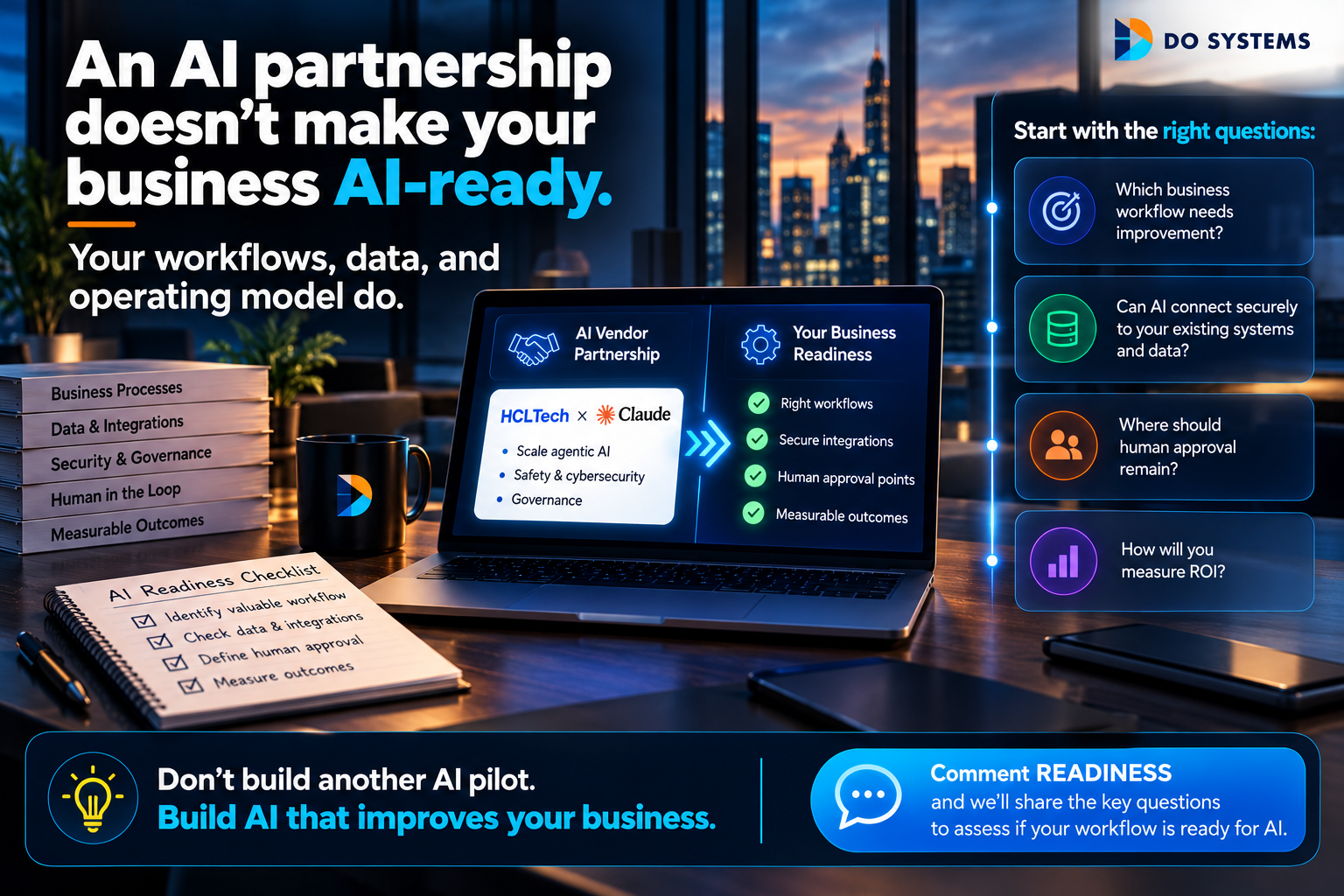
The partnership signals a shift from model access to delivery
HCLTech said it would create a dedicated Anthropic business unit and Center of Excellence to build agentic AI solutions, while HCLSoftware would embed Claude and Claude Code in selected enterprise products. The announcement reflects how AI adoption increasingly depends on more than access to a capable model. Organizations also need implementation expertise, integration paths, controls, and a way to connect technical capabilities to business outcomes.
A mid-size company does not need to copy the scale of a global systems integrator to learn from this shift. It does need to recognize that model access is only one component of the work. The workflow still has to be understood, connected to the right systems, tested against real cases, and supported after launch.
Why a promising AI demo can still fail in production
A demo typically begins with a clean prompt and a narrow objective. A real workflow has exceptions, missing information, permissions, legacy applications, and people who need to understand or approve what happens next. A model may perform well in isolation and still create friction when it is connected to a CRM, ticketing platform, finance system, inbox, or operational database.
The danger is not limited to technical errors. If a team cannot explain which data the AI uses, who owns the final decision, or what happens when the output is wrong, adoption may stall after the pilot. Staff may work around the new system, managers may distrust its results, and the business may end up maintaining both the old and new processes.
Use a workflow-first readiness test before choosing the solution
A practical readiness test begins with the business outcome. Identify the process delay, error rate, backlog, or service problem the organization wants to improve. Then map the current steps and identify where AI could remove repetitive work or improve decision support without taking over decisions that need human judgment.
Next, examine the data and integration path. Determine which records the workflow needs, whether the data is accessible and reliable, which systems can be changed, and what permissions the AI component would require. Define the handoff to a person, the exceptions that should stop automation, and the evidence that must be logged. Finally, establish a baseline and a success threshold before launch so the team can tell whether the new workflow actually improved.
This sequence helps prevent a common mistake: selecting a model first and then searching for a problem that justifies it. A readiness assessment gives technical and business leaders a shared basis for prioritization and makes vendor conversations more concrete.
A practical illustration: automate a workflow, not an isolated task
Consider an internal operations team that receives a high volume of requests by email. A standalone AI assistant might summarize each message, but a workflow-oriented implementation would also classify the request, retrieve the right context, identify missing information, route it to the appropriate owner, and keep a human involved when the decision is sensitive. The value comes from improving the complete process, not from generating a polished summary alone.
That is the same principle behind DoSystemsInc’s Executive Email Assistant, which connects Outlook messages to operational categories such as Act Now, Decide, FYI, and Compliance. The category is useful because it links AI output to a next step a person can understand. The broader lesson is transferable: define the action and accountability around the AI output before adding more autonomy.
Measure readiness by operational evidence, not by the number of pilots
A company can have many AI experiments without building a repeatable way to deploy them. More useful signals include whether the team has a documented workflow owner, an approved data path, test cases for normal and exceptional situations, clear human escalation, monitoring, and a measurable target. These elements make it easier to compare use cases and determine which should move into production.
The first deployment should also create reusable patterns. A standard approach to identity, integration, logging, evaluation, and human review can reduce the effort required for the next workflow. Reuse should not mean forcing every use case into the same design; it means reusing proven controls while adapting the workflow to its actual risks.
Where this goes next
DoSystemsInc helps teams assess enterprise AI readiness, choose a workflow with a clear business case, and design the integrations and controls required for production. If you are evaluating an AI initiative, comment READINESS or reach out to discuss an AI integration project or MOU.
Comments are closed