
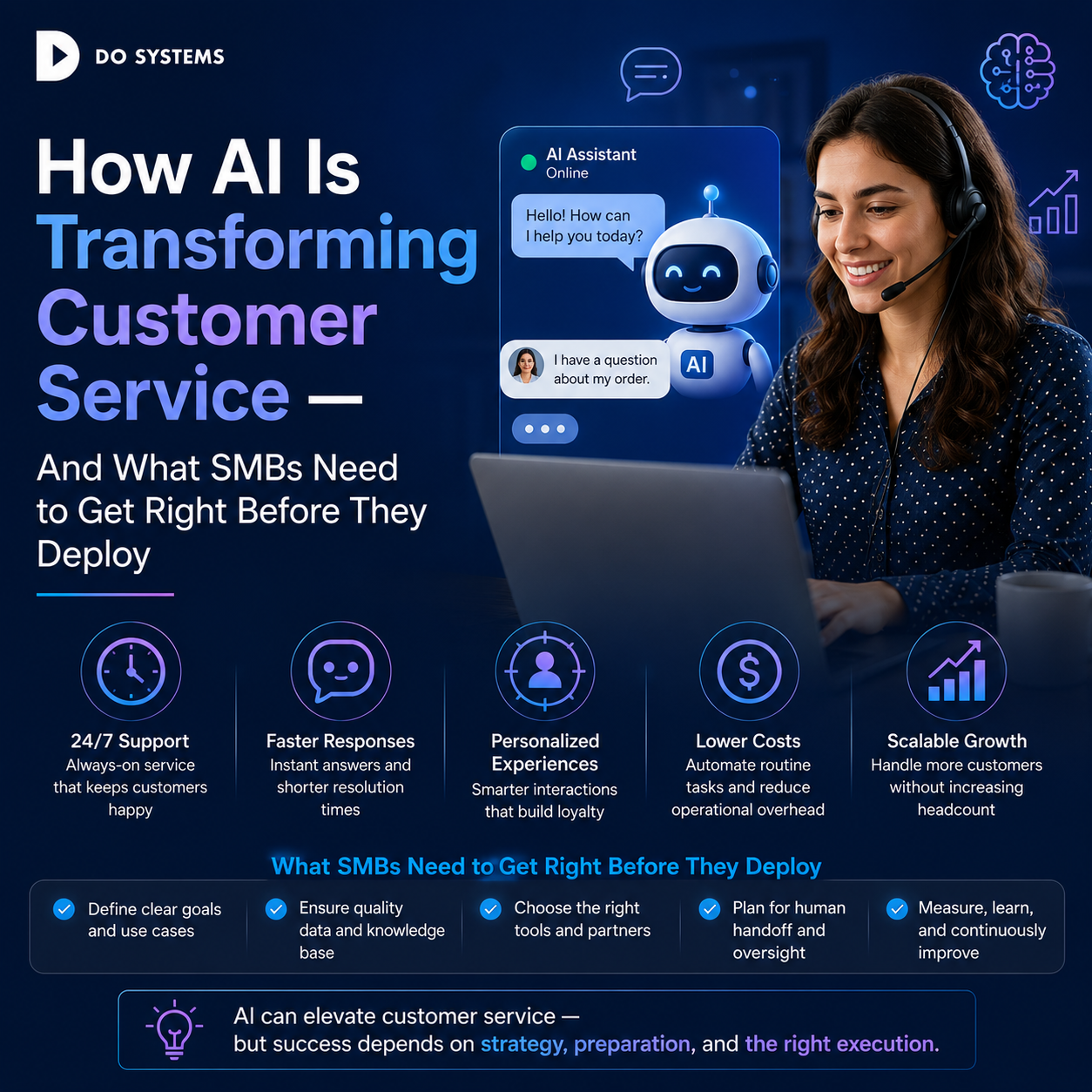
The number of businesses using AI in customer service nearly doubled in two years. Salesforce’s seventh edition State of Service report drawing on 6,500 service professionals and decision-makers surveyed between April and June 2025 found that 66% of service organisations now run AI agents, up from 39% the previous survey period. That is a 1.7x increase in a single year.
The pressure is not coming only from customers, who increasingly expect 24/7 availability and fast responses. It is also coming from service economics: the cost of scaling a human support team linearly with customer volume is not sustainable for most SMBs. AI changes the unit economics of customer service.
But the gap between deploying AI and getting value from it is real. 70% of organisations that deploy AI agents see measurable value within 60 days but the 30% that do not have a consistent pattern of avoidable problems.
What AI Actually Does in a Customer Service Context
AI handles well: high-volume, low-complexity queries that follow predictable patterns. Order status, account lookups, appointment scheduling, FAQ responses, basic troubleshooting flows with defined resolution paths. These queries typically represent 40-60% of total ticket volume in most SMB service operations.
AI handles poorly: emotionally charged interactions, novel problems that fall outside training data, nuanced policy interpretations, and situations where the customer’s underlying issue differs from what they have actually asked. These are not failures of current AI they are structural characteristics of the technology.
The practical implication: AI in customer service is a deflection and triage layer, not a replacement for human service. Reps using AI spend 20% less time on routine cases, freeing an estimated four hours per week for complex work, according to Salesforce’s 2025 State of Service research. That is the design intent not elimination of service roles, but reallocation of them.
79% of service leaders in Salesforce’s research say that investing in AI agents is essential to meeting current business demands. 71% of service reps who use AI say it is creating growth opportunities in their role. Both numbers suggest the human-AI collaboration model is working where it has been implemented thoughtfully.
Three Decisions to Make Before You Deploy
The organisations that see value quickly made these three decisions before deployment, not during or after it.
- Use case selection based on volume and data, not excitement. The single most reliable predictor of AI customer service success is selecting a use case where you have clean historical data and consistent query patterns. Review your ticket data for the past 12 months. Identify the top 5 query types by volume. Check whether each has a defined resolution path. Start with the one that is highest-volume, most rule-based, and has the cleanest data.
- Channel integration readiness. AI customer service needs to connect to your CRM, help desk system, and knowledge base. Before you select a vendor, map your integration dependencies. The most common deployment delay is discovering mid-implementation that the AI vendor’s API does not connect cleanly to your CRM. This is solvable but needs to be identified before the contract is signed.
- Handoff design before launch. The quality of the AI-to-human handoff determines customer experience when AI reaches its limits. Define the triggers: which query types, which frustration signals, which unresolved states escalate to a human and what context transfers with them. A handoff that passes only a ticket number forces the customer to repeat themselves. A handoff that passes the conversation history and customer account status saves rep time and preserves trust.
How to Evaluate AI Customer Service Vendors
What does your resolution rate look like on queries like mine not your benchmark dataset, my actual query types? Ask for documented resolution rates from reference customers whose query mix and industry match yours. Headline resolution rates from vendor marketing are typically measured on the easiest query types.
How does your system handle out-of-scope queries? Every AI system has an out-of-scope handling mechanism. A system that confidently gives a wrong answer to an out-of-scope query is more dangerous than one that immediately escalates. Ask to see examples of out-of-scope handling from reference customers.
What does your retraining process look like? Customer queries change over time new products, new policies, new seasonal patterns. Understanding the vendor’s retraining process and timeline tells you how quickly the system adapts to your evolving needs.
What are your data processing and security commitments? Any AI system processing customer conversations handles personal data. A data processing agreement and clear data retention policy are prerequisites for procurement.
What Good Looks Like After 90 Days
A healthy 90-day deflection rate for a well-implemented first use case is typically 25-40%. Lower suggests either the wrong use case was selected or the AI is escalating too aggressively. Higher in the first 90 days warrants inspection very high deflection rates sometimes mask poorly configured escalation triggers.
Customer satisfaction on AI-handled interactions should be tracked separately from overall CSAT. It is normal for it to be slightly lower in the first 30 days as the system calibrates. It should be tracking upward by day 60. If it is not, the issue is usually either query type mismatch or handoff quality.
Escalation reason analysis is the most underused diagnostic tool. Reviewing why queries escalate which patterns emerge, which resolution paths are missing is the fastest way to improve the system. The organisations that improve fastest treat this as a weekly ritual, not a quarterly report.
Frequently Asked Questions
How much does AI customer service cost for a small business?
Cloud-based AI customer service platforms typically range from $200-$2,000 per month for SMB tiers, depending on conversation volume and integration complexity. The right starting point is to size the investment against the cost of the queries you expect it to handle — if AI deflects 500 queries per month that would otherwise require 20 minutes of rep time each, the labour saving calculation is straightforward.
How long does AI customer service implementation take for an SMB?
Cloud platform deployments for SMBs typically take 4-8 weeks from vendor selection to live operation for a single-channel, single-use-case deployment. Multi-channel, multi-use-case deployments take longer. The primary variable is integration complexity how cleanly the AI platform connects to your existing CRM and helpdesk.
Will AI replace my customer service team?
The evidence from current deployments suggests not. Salesforce’s 2025 State of Service data shows 71% of reps using AI report it is creating growth opportunities in their role. The more consistent pattern is reallocation AI handles routine queries, allowing human reps to focus on complex, high-value interactions.
What data do I need to train an AI customer service system?
Most cloud-based platforms are pre-trained on general language understanding and require configuration rather than training from scratch. You typically need: 12 months of historical ticket data, your product and service knowledge base in structured format, defined resolution paths for your top query types, and API access to your CRM for customer data lookup.
Comments are closed