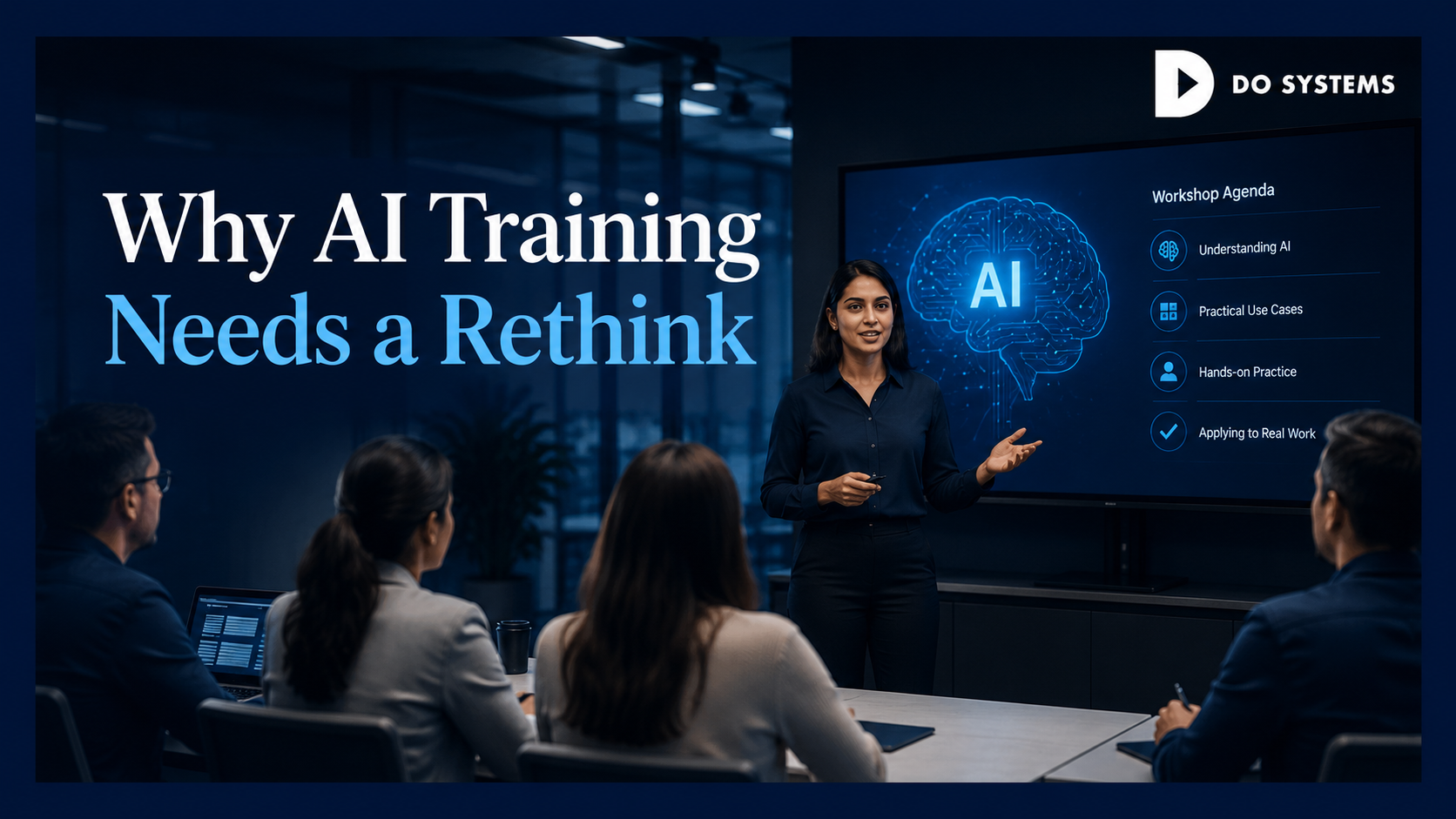
Manpower Group’s 2026 Global Talent Barometer found that while regular AI usage has jumped 13% to 45% of workers, 56% of the global workforce reported receiving no recent training. Workers are adopting AI tools without structured support – which means they are learning through trial and error, developing inconsistent practices, and arriving at different conclusions about what the tools can and cannot do.
The WEF Future of Jobs Report 2025, based on surveys of over 1,000 global employers representing more than 14 million workers, found that 63% of employers identify the skills gap as their primary barrier to AI transformation. The same report found that 80% of employers plan to upskill workers with AI training – yet 56% of workers say they are receiving no such training.
The gap between employer intent and employee experience is not primarily a resource problem. It is a programme design problem. Most AI training programmes are built to check a box – an awareness session, a product tour, an e-learning module – rather than to change how people work. This guide focuses on what actually changes behaviour.
Why Most AI Training Doesn’t Change Behaviour
A consistent pattern emerges in businesses that have run AI training and found limited adoption afterwards. The training was generic. It introduced AI concepts, demonstrated what the tools could do in general, and provided access to the tools. Then it ended. What it did not do was connect the AI to the specific tasks the attendees perform every day.
A finance team member who attends an AI training session and learns that AI can ‘help with writing and analysis’ has received true but useless information. A finance team member who learns specifically how to use AI to draft the monthly management commentary from actuals, how to cross-check variance explanations against prior period narratives, and how to flag the prompts that reliably produce useful first drafts versus the ones that require heavy editing – has received training that changes their next working day.
The WEF finds that 39% of core workforce skills will be transformed or obsolete by 2030. Generic awareness training does not prepare people for transformation. Role-specific, task-connected skill development does.
What Training Format Actually Changes Behaviour
Role-Specific Rather Than Generic
Generic AI training reaches everyone and changes almost no one. Role-specific training reaches a smaller group and changes how they work. The economics strongly favour the latter.
Segment your workforce by function and identify the three to five highest-value AI applications for each segment before designing any training. The finance team needs different content from the sales team, which needs different content from the customer service team. The AI tool might be the same; the use cases, the prompts, the quality review process, and the risk considerations are all different.
Task-Connected Rather Than Theoretical
Every training module should connect directly to a real task the participant performs. Not ‘here is how to write prompts’ but ‘here is how to use AI to complete this specific task you do every week, with these specific prompt structures, and here is how to review the output before you use it.’ Participants should leave every session with something they can apply in their next working day.
Short-Cycle with Immediate Application
Multi-day AI training events produce lower behavioural change than weekly 60–90 minute sessions spread over 6 weeks. The reason is application: participants who apply what they learned between sessions bring real questions to the next session, encounter real limitations, and develop real confidence. Participants who attend a two-day event and return to their desk without applying anything for a week lose most of what they learned.
Build application tasks into the programme design. After session two, participants complete a specified task using AI before session three. The task is reviewed together at the start of the next session. This structure produces learning, accountability, and shared examples.
The Four Elements of Effective In-House AI Capability Building
First: a designated AI champion in each team. This does not require a new headcount. It requires identifying the person in each team who is most naturally curious about AI tools, giving them structured development time, and positioning them as the first point of contact for colleagues with questions. The champion network multiplies training reach without proportional cost.
Second: a shared prompt library for each function. A curated, team-maintained library of prompts for the five to ten most common tasks – with notes on what works, what needs editing, what to watch for – is more valuable than any formal training programme. It embeds institutional knowledge and improves over time as the team adds to it.
Third: a clear escalation path for questions and concerns. Employees who encounter AI outputs that seem wrong, AI recommendations they disagree with, or situations where they are unsure whether AI is appropriate should have a clear path to ask and get an answer. Without this, uncertainty resolves in two ways: people stop using AI tools, or they use them without appropriate review.
Fourth: a review cycle. AI capabilities change. The prompts that work best today may not be the most effective six months from now. New use cases become viable as tools improve. A quarterly review of the prompt library and a half-year assessment of the training programme keeps the capability development current.
Frequently Asked Questions
How much does AI skills training cost?
Internal AI skills programmes can be built at low cost if the content is developed in-house by existing AI champions rather than purchased from external providers. External facilitation for the initial programme design and first cohort typically runs £5,000–£20,000 for a mid-sized team. Ongoing maintenance is primarily internal time.
Should we use an external AI training provider?
External providers are useful for the initial programme design and the first delivery, particularly if no internal AI champions exist yet. The goal should be to develop internal capability to run and update the programme rather than creating ongoing dependency on external delivery.
How do we measure whether AI training is working?
Three metrics: adoption rate (what percentage of the target group are using AI tools for the target tasks at 30/60/90 days), output quality (are AI-assisted outputs better than pre-AI baselines, assessed by managers reviewing samples), and self-efficacy (are participants more confident using AI for work tasks, measured by simple survey). All three should improve over a 90-day programme window.
Comments are closed