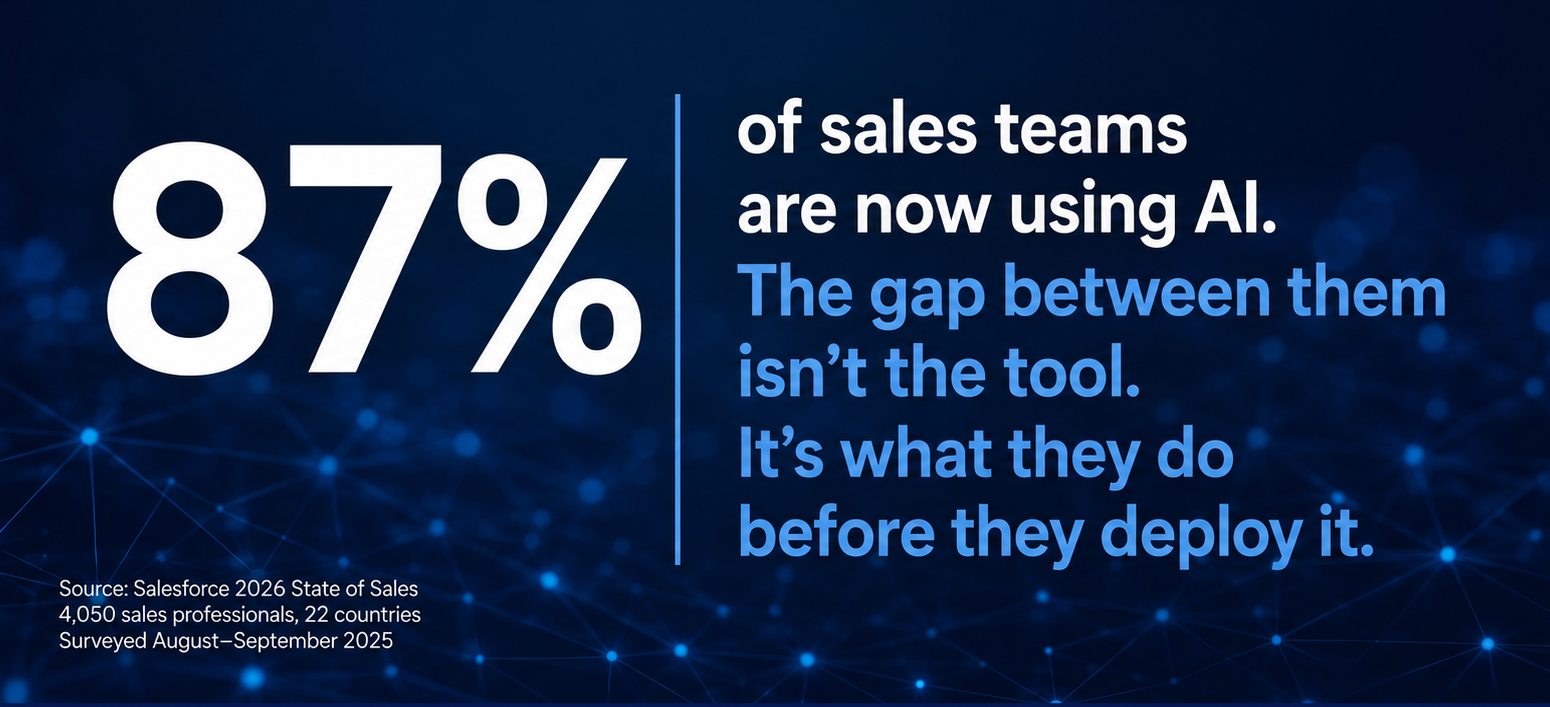
Salesforce’s 2026 State of Sales report – a survey of 4,050 sales professionals across 22 countries conducted in August and September 2025 – found that 87% of sales organisations now use some form of AI. Within those organisations, 94% of sales leaders with AI agents in place say those agents are critical for meeting business demands.
Those numbers suggest AI in sales is working. And for some teams it is. But the same report shows that implementation maturity varies enormously. The difference between teams getting real returns and teams running tools that produce no measurable change comes down to three things: use case selection, data quality, and adoption design. This guide covers all three.
Before that: a note on what ‘AI for sales’ actually means. The category is broad. It includes simple features built into your existing CRM – lead score updates, next-step suggestions, email drafting assistance. It includes standalone platforms that analyse call recordings and provide coaching. It includes AI systems that forecast pipeline and flag deals at risk. The economics and implementation complexity vary significantly across these. We treat each separately.
Where AI Is Genuinely Delivering in Sales
Three categories are generating consistent, measurable returns in sales teams at business scale.
Lead Scoring and Qualification
The traditional approach to lead qualification relies on sales reps making judgement calls based on limited information, inconsistent criteria, and whatever they happened to notice in the CRM. The result is variable and slow.
AI-based lead scoring works by training a model on historical conversion data – which leads converted to customers, at what deal size, in what timeframe – and scoring incoming leads against those patterns in real time. When the underlying CRM data is clean and the historical dataset is large enough, the accuracy improvement over human scoring is consistent and significant.
The requirement: sufficient historical conversion data and CRM data that accurately reflects lead attributes. Businesses with fewer than 200 closed deals in their CRM data are unlikely to have enough signal for a reliable model. The right starting point in this case is improving CRM data quality rather than deploying AI scoring on top of incomplete records.
CRM Data Enrichment and Automation
A consistent finding in sales operations research is that CRM data quality is the primary limiting factor in sales AI performance – not the AI itself. Sales reps under-record. Records go stale. Contact information decays. The AI’s outputs are only as good as the data it runs on.
AI-based CRM enrichment addresses this in two ways. First, it automates the capture of activity data – call logs, email threads, meeting notes – that would otherwise depend on rep discipline to record manually. Second, it pulls in third-party data to fill gaps: company size, technographics, intent signals. The result is a CRM that reflects reality rather than whatever the rep last entered.
The business case is direct: more complete data improves every downstream AI application. Lead scoring improves. Forecasting improves. Rep productivity improves because they spend less time on manual data entry. The enrichment layer is foundational rather than optional.
Call Intelligence and Coaching
Call intelligence platforms transcribe sales calls, identify patterns in high-performing conversations, and surface coaching recommendations for individual reps. Salesforce’s 2026 State of Sales found that 89% of sellers using AI say it deepens customer understanding – call intelligence is a significant contributor to that finding.
The practical benefit for sales managers is significant: instead of reviewing calls manually and providing coaching based on a small sample, managers can see patterns across every call the team makes. Topics where objections cluster. Competitors mentioned. Talk-to-listen ratios. Pricing conversations. The coaching becomes data-driven rather than impression-based.
The deployment requirement is consent and recording policy. Before implementing any call recording system, legal and compliance review of recording consent requirements in every jurisdiction your team operates in is not optional. This review should happen before procurement, not after implementation.
Where Sales AI Budgets Are Being Wasted
Not all sales AI is delivering returns. Two patterns account for most of the wasted spend.
The first is deploying AI that replaces human judgement before trust has been established. An AI-generated lead score that a rep does not trust is worse than no score – the rep ignores it but the organisation has paid for the tool and believes the problem is solved. Adoption design – introducing AI recommendations gradually, showing reps the reasoning, and building in feedback loops – is as important as the model quality.
The second is deploying AI on top of poor data. An AI that analyses your sales conversations based on incomplete call recordings produces incomplete analysis. A forecasting model that runs on a CRM missing 40% of deal activity will produce inaccurate forecasts. These are not AI failures – they are data quality failures that surface when AI is applied. The fix is upstream of the AI deployment.
What Separates Sales Teams Getting ROI
Salesforce’s 2026 research identified that 54% of sellers have used AI agents – autonomous AI that can take actions like updating CRM records, scheduling follow-ups, or drafting outbound sequences without manual triggering. Among sales leaders with agents in place, 94% describe them as critical to meeting business demands.
The organisations seeing the highest returns from sales AI share four characteristics. They selected use cases with clear, measurable success criteria defined before deployment. They treated CRM data quality as a prerequisite rather than a follow-on task. They introduced AI tools to reps through training and visible demonstrations of value, not mandates. And they measured adoption and output quality in parallel – not just whether reps logged in, but whether AI recommendations were acted on and whether those actions produced better outcomes.
The tools matter less than these four characteristics. A well-implemented basic feature inside your existing CRM will outperform a sophisticated standalone platform deployed without an adoption plan.
Frequently Asked Questions
What is the best AI tool for sales teams?
The best AI tool is the one that matches your use case, data maturity, and team size. For most businesses, the right starting point is the AI features inside your existing CRM – Salesforce Einstein, HubSpot AI, or Microsoft Copilot for Sales. Standalone platforms for call intelligence or forecasting make sense once the foundational CRM data quality is in place.
How much does AI for sales cost?
Costs vary widely. CRM-embedded AI features are often included in existing licences or available as low-cost add-ons. Standalone call intelligence platforms typically range from £50–£200 per seat per month. Dedicated forecasting platforms are higher. The more relevant question is total cost of ownership including implementation, data preparation, and training.
How long does it take to see ROI from sales AI?
Lead scoring and CRM automation can show measurable impact within 60–90 days of a well-implemented deployment. Call intelligence coaching impact on conversion rates typically emerges over a 3–6 month window. Pipeline forecasting accuracy improvements are visible within a quarter. All timelines assume adequate data quality and adoption.
Comments are closed