
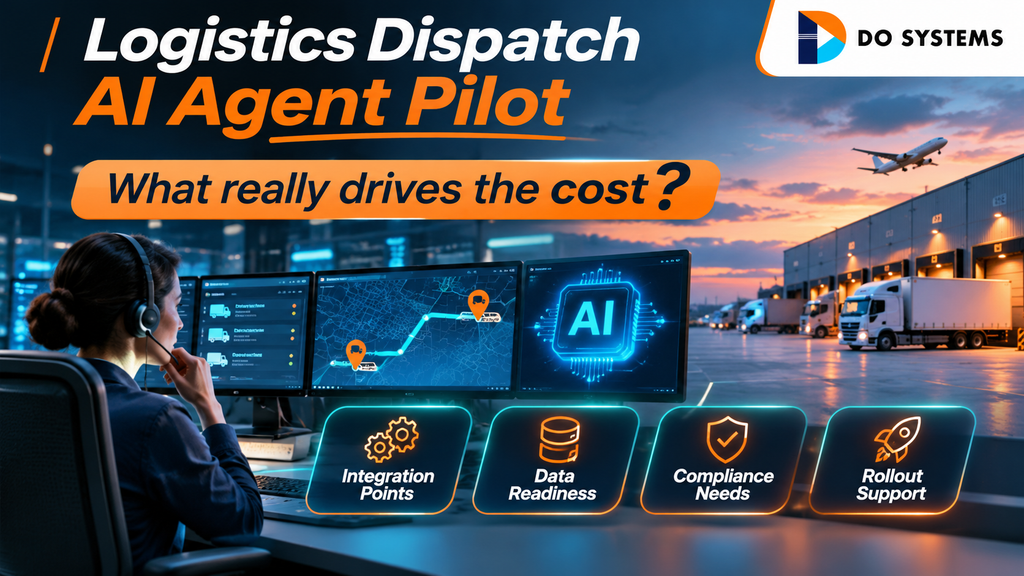
The Real Question Isn’t Cost. It’s Scope
When leadership asks what a dispatch AI agent costs before the process is named, the question has no answer yet. Cost follows scope, not the other way around. Four factors decide the price of a pilot: how many systems the agent must write into, how ready the underlying data is, how much compliance review that data triggers, and how much support the rollout needs after the pilot ends. Name those four before asking for a number. Skip them, and any figure handed back is a guess wearing a decimal point.
Integration Points Decide the Price
Dispatch decisions can touch load boards, driver communication tools, routing systems, and billing. Each system the agent must read from or write to adds cost. An agent that only reads data and hands a recommendation to a human dispatcher costs less to build than one that writes decisions directly back into operational systems. Count the write-back points before scoping, not after.
This maps directly to the Systems & integration point on the AI readiness checklist: name every system the output must reach, and confirm each one exposes an API or a supported integration path. A team that cannot name those systems isn’t ready to price a pilot. It’s ready to find out why, which is a different conversation and a shorter one than it sounds.
Data Readiness Is the Hidden Cost Driver
Dispatch data can live in load histories, driver logs, fuel cards, and sometimes a spreadsheet one person maintains by hand. The Data access point on the checklist asks a blunt question: can the team pull what this process needs within a week, without a data project first? A pilot that skips this question does not get cheaper. It can pick up a second, unplanned project buried inside the first one, discovered halfway through a build.
An operations lead who knows where the data lives, who owns it, and whether it’s current can scope a pilot fast. A team still answering that question needs to finish that work first, as its own effort, separate from any AI engagement. Folding data cleanup into pilot scope hides the real cost instead of pricing it.
Compliance Review Is Not Optional
Freight data includes driver location, carrier contracts, and rate information that may carry contractual or regulatory limits specific to the business. The Security & compliance point on the checklist asks whether security and compliance have signed off on what data may leave the environment, for this process, before a pilot starts.
Skipping that sign-off doesn’t remove the cost. It moves the cost to later, to the point where a compliance review stops a pilot that’s already built and funded. Name the compliance reviewer before scoping starts. Reject any pilot plan that doesn’t include that name on it, in writing, with a date.
Rollout Support Is the Line Item Everyone Forgets
A pilot that works and then goes nowhere is a risk the checklist addresses in its Budget & timeline point. A pilot can get funded while its rollout does not. Before committing to a pilot, ask who owns the process after it moves to production, what happens to the agent when the pilot period ends, and whether budget for that next stage already exists on paper.
The Ownership point matters here too. A named business owner, paired with a technical counterpart, stays accountable after the demo is over. A project that belongs to “IT” or “innovation” alone, with operations absent from the room, may not survive the handoff from pilot to production. That’s not a technology problem. It’s a scoping gap that shows up months later as a stalled rollout.
Scope First, Then Price
None of this gets answered by a sales deck. It gets answered in a scoping conversation that walks through one process, one owner, one metric, and names every system and every compliance question before anyone commits to a build. That conversation is what makes cost drivers visible instead of hidden inside a quote.
Name the process. Name the owner. Name the systems. Set the pass/fail threshold before the work starts, not after the demo looks good. That’s the checklist’s success criteria point, and it’s non-negotiable: a pilot without a defined pass/fail threshold isn’t a pilot. It’s an open-ended expense with no exit. Run the Build, buy or partner question honestly too. Who monitors and fixes this agent after launch matters as much as who builds it.
A dispatch operation that works through these points before asking for a number gets a real scope back. One that skips them gets a range that is hard to defend to a CFO.
DoSystems runs a free 45-minute AI strategy session built for exactly this situation. It maps one high-ROI process in the dispatch operation and returns a 6-8 week pilot scope, so the cost drivers are visible before anyone commits budget to a build. Book the session to get a scope instead of a guess.
Free 45-minute AI strategy session
FAQ
What determines the cost of a dispatch AI agent pilot?
Cost follows four drivers: the number of systems the agent integrates with, how ready the underlying data is, the compliance review the data triggers, and the support needed to carry the pilot into production. Scope each one before asking for a price.
How long does a dispatch AI pilot take?
The free 45-minute strategy session maps one process and gives you a 6-8 week pilot scope. The exact plan still depends on the integration points and data readiness specific to that process.
What happens to the pilot after it proves out?
That depends on whether rollout was planned before the pilot started. Name a budget and an owner for the rollout stage during scoping, not after the pilot succeeds, or a working pilot can stall for lack of funded next steps.
Comments are closed